

Are you training harder than you should be?
Wet outside. School holidays. Two kids at home. So the turbo trainer in my home office has been getting a hammering. And because building air quality monitors is what I do, I pointed one at myself to see what an hour of riding does to a closed room. Short answer: nothing good.
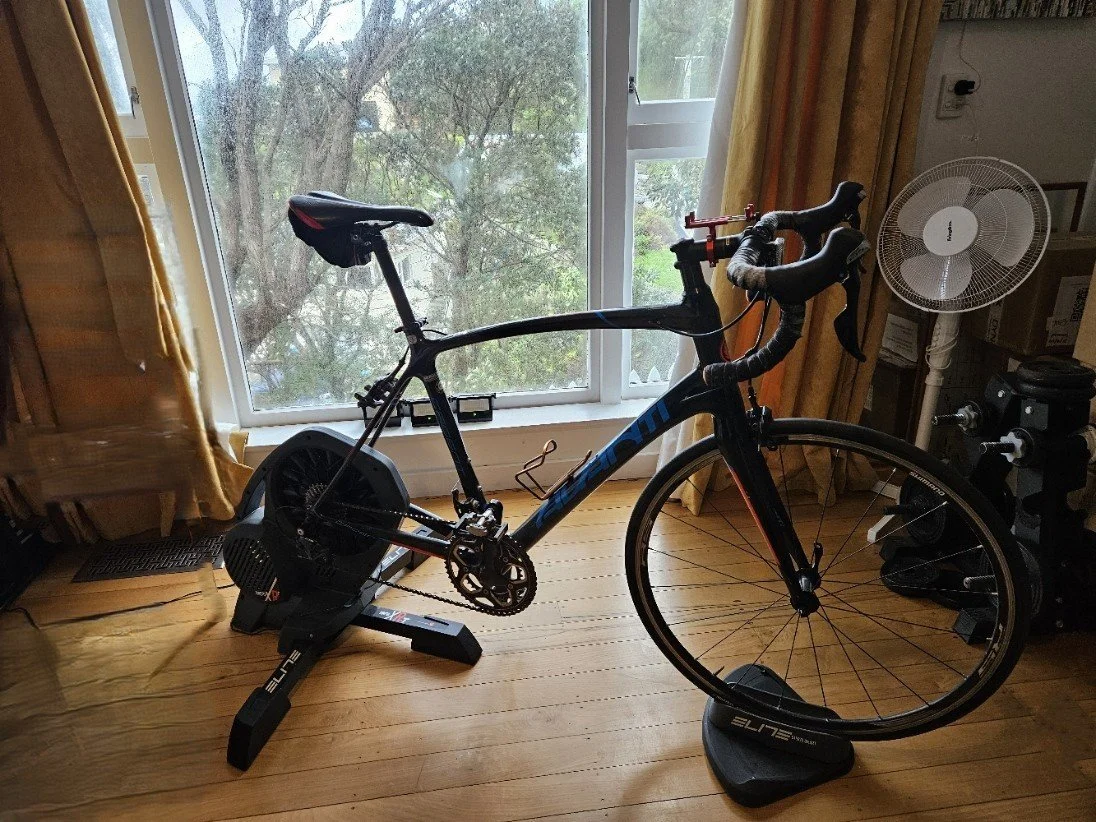
The monkey training station
Why exercise makes this worse
Here's the mechanism. Cardio means breathing harder, that's the whole point. At rest you might move 6 litres of air a minute. Riding hard, it's ten times that. Every one of those breaths comes back out loaded with CO2, roughly a hundred times the concentration of the air you pulled in.
In a big, well-ventilated space that barely registers. In a closed room with the door shut (my daughters don't like Metallica), it has nowhere to go. It just accumulates. And the more I pedalled, the more CO2 I puffed out, and the deeper and faster I was breathing it back in.
Monkey experiment
Normally, when I use my turbo trainer, I open all the windows as far as they will go and I blast a $30 pedestal fan into my face. I crank the music and bring the pain. The whole point of today's experiment was to see what would happen if I left the windows closed. Everything else as usual. My home office isn't anything special. It's just a 4m by 3.5m room with a desk one side, a few shelves and a bike on the other, and an assortment of crap in the corner. There are 2 windows, each of which opens about 15cm, plenty to keep the room fresh. But today, I left the windows closed, jumped on the bike, and within 30 minutes I felt like I was cycling up the side of Mount Everest on a bike made out of lead. To keep things vaguely scientific, I did the exact same ride that I'd done a few days earlier, a 24 km circuit around Belgium with a few small hills. A decent ride but easy enough. This time, however, I had to bail before the end.
The thing that shocked me most wasn't how different the experience felt. It was that nothing about it was obvious. CO2 is odourless and invisible. Yet I felt absolutely destroyed after only half the session I'd done easily a few days ago. It's not going to be a huge reveal, but the CO2 concentration was past 3000 ppm at this point. I felt sluggish and I could feel a headache coming on. So I opened all the windows, and called it a day.
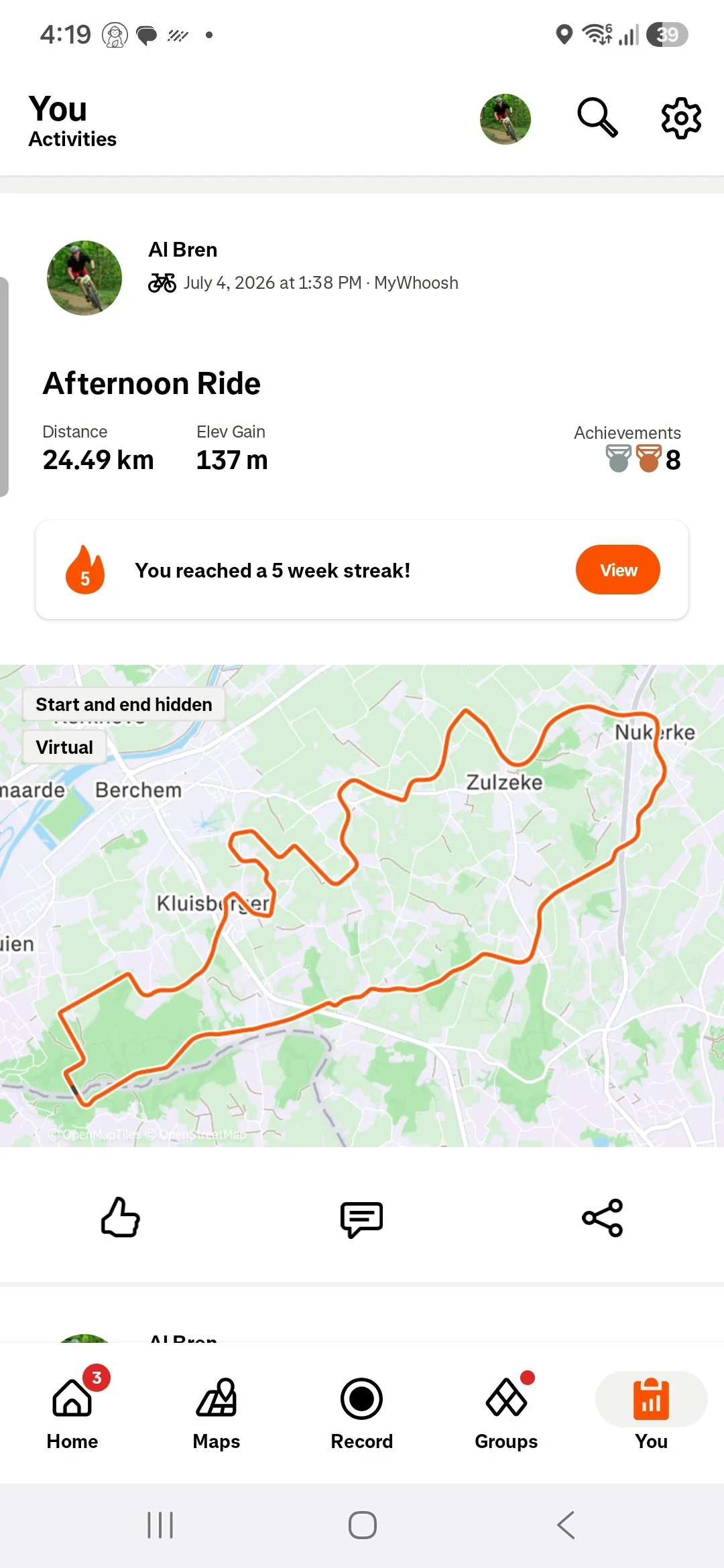
Easy Ride with lots of fresh air!
Actual evidence!
It would be easy to write this off as one unfit bloke in a stuffy room. So I went looking to see if it was just me.
It isn't. In 2022, RNZ ran a project called "Whose Breath Are You Breathing?" They walked around Auckland gyms and studios with a CO2 meter. A spin class read 2,086 ppm. A yoga class hit 4,228. For reference, outdoor air is about 400, and New Zealand guidance says keep indoor spaces under 1,000. The US CDC reckons 800. So these rooms weren't a bit over. They were four to five times past the line.
And it's not just the odd bad day. A peer-reviewed study across eight health clubs found the same pattern I saw at home: the small, enclosed group-class rooms were consistently the worst, because more people breathing hard in less air builds up faster than it can clear. Exactly like my office, just with a better sound system.
What it's actually doing to you
Here's why the sluggish-and-headachey thing happens. At the levels I was hitting, CO2 isn't poisoning you. But it does measurably dent concentration, decision-making and how hard a session feels. That's the bit that got me: I wasn't imagining the lead bike. The air had genuinely turned my easy ride into a slog.
There's a second reason to care, especially in a shared gym. A high CO2 number is really a stale-air number. It tells you the air you're breathing has already been through someone else's lungs. Whatever else is floating around in there, other people's viruses included, is building up right alongside it.
You can't fix what you can't see
This is the whole reason I do what I do. The most unsettling part of my experiment wasn't feeling terrible. It was that nothing told me why. No smell, no haze, fan still going, music still loud. If I hadn't had a number on a screen, I'd have blamed my legs, my sleep, my breakfast, anything but the actual cause.
That's the thing. Bad air is invisible and it creeps, so your gut is useless at spotting it. A sensor turns an invisible problem into a number you can act on. Nothing clever. Just: see it, fix it, check it worked.
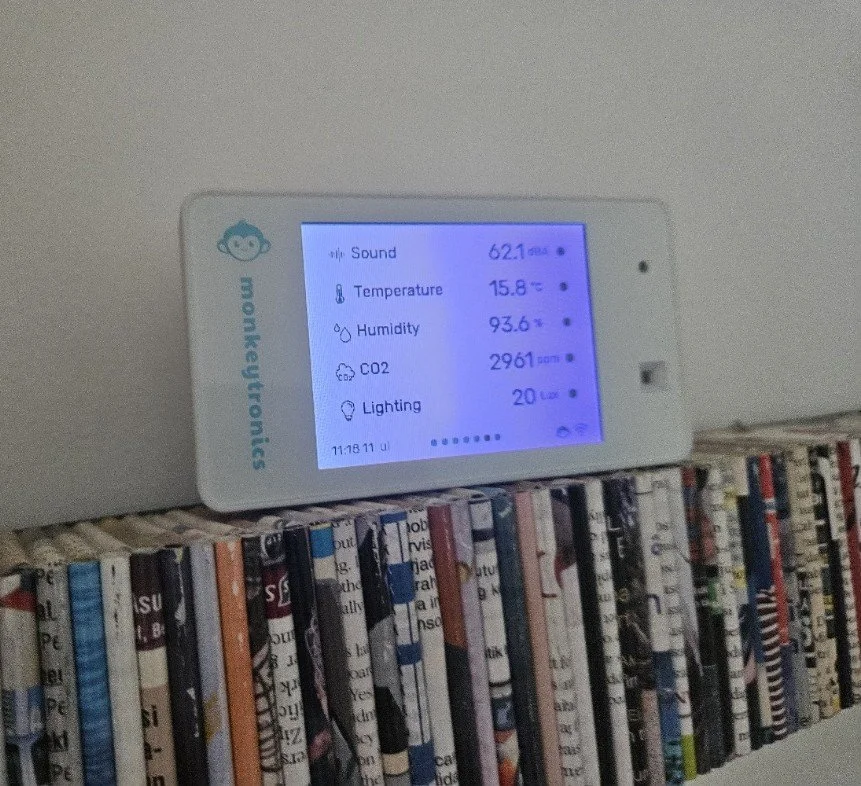
2961 ppm of Carbon Dioxide and Relative Humidity at nearly 94%.
What to actually do about it
The fix is dead simple. Open a window. Point a fan. Leave the door open (sorry, kids). When I do all that, my room stays under 1,000 the whole ride. Same session, completely different experience.
If you run a gym or a studio, put a monitor on the wall where people can see it. It's the honest move, and it's a quiet trust signal to members: we know what's in the air, and we're managing it. Fresh air is the cheapest performance upgrade in the building.
I build these things for a living and I was surprised by what this taught me. So if you train indoors and you've never looked, look. You might be working a lot harder than you need to, for reasons you can't see.