

Smart Spaces: Upgrading our Academic Infratructure
Top universities spend a fortune getting the teaching right. Course design, hiring the best academics, pastoral support, endless student satisfaction surveys. Then they sit three hundred students in a sealed lecture theatre for an hour and never once asks what the room itself is doing to them. At least that was my experience!
Temperature, humidity, CO2, lighting and sound levels each have a measurable effect on how well people think, and in a packed teaching space they all drift the wrong way at once. The catch is that none of it is visible. A lecturer can spot an empty seat, or someone flicking a monster munch at the back of another kid’s head. They can't spot 2,800 ppm of CO2, or a room that's crept up to 27 degrees, or a reverberation time that's turned their voice to mush by the time it’s reach the back row. So it goes unmanaged, because nobody's measuring it.
Here's what the research says about each one, and why it's worth putting a number on.
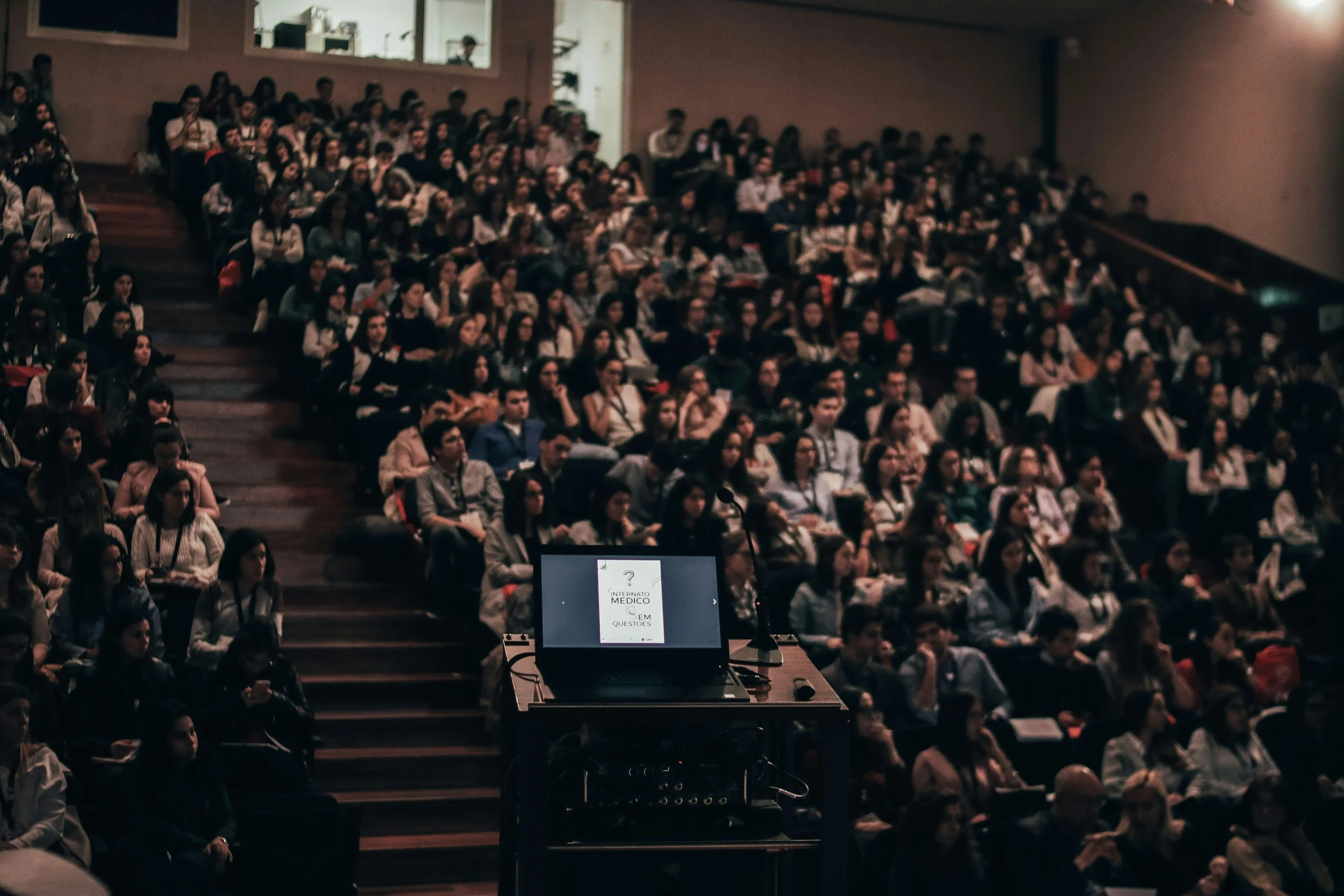
Photo by Miguel Henriques on Unsplash
CO2: ruining your grades
High carbon dioxide levels map straight onto how well students think, and it's worst in packed rooms.
Joseph Allen's team at the Harvard School of Public Health ran their "COGfx" studies on indoor air and the brain. They found cognitive function scores dropped by around 21% for every 400 ppm rise in CO2, and that people working in well-ventilated conditions scored roughly double those in stuffier, conventional ones (Harvard COGfx). And we're not talking about feeling a bit sleepy. This is decision-making, using information, thinking strategically. The exact stuff you're asking students to do.
The fair objection is that a lab isn't a lecture theatre. So the useful follow-up is a 2025 study from the same Harvard group that put monitors in real university classrooms and tracked graduate students' cognitive test scores. Even across the fairly low CO2 range in those rooms, lower CO2 lined up with higher scores (study). They showed an association, which might not be proof of cause but it points exactly where you'd expect.
And the levels are real. At Monkeytronics, we’ve been measuring this for years all across New Zealand. Elevated CO2 concentrations are present in almost every classroom in the country. Independent surveys of classrooms routinely find CO2 above 1,000 ppm, a good chunk above 2,000, and some past 3,000 (reference). New Zealand guidance is to stay under 850 ppm. A full lecture theatre with the doors shut sails past that inside the first half hour. By the end of some lectures, the students are glazed over and struggling to keep their eyes open. Even in subjects as interesting as control theory.
Temperature and humidity: comfort isn't a soft metric
Get the temperature wrong and performance drops in a way you can actually measure. Pawel Wargocki, one of the big names in indoor environment research, pulled together 18 classroom studies and estimated that cooling a hot room from 30 down to 20 degrees improves performance on learning-type tasks by roughly 20% (Wargocki meta-analysis). A 2025 experiment in Frontiers in Built Environment, run in an actual university classroom, landed on a sweet spot of about 20 to 22 degrees, with motivation and exam performance both tracking how thermally comfortable students were (study).
The stakes are highest exactly where you're least likely to be watching: the exam hall in a warm spell. R. Jisung Park and colleagues, writing in the American Economic Journal, tracked 10 million US students who resat the PSAT and found hotter school years dragged their scores down. Without air conditioning, a single degree Fahrenheit hotter over the year knocked about 1% off that year's learning (Heat and Learning). Heat doesn't just make a hot exam unpleasant. It wrecks the whole year’s work.
Humidity rides along with all this. Too high and the room feels stuffy and warmer than it is. Too low, which is what winter heating does, and you get dry eyes, scratchy throats and viruses lasting longer in the air. Somewhere around 40 to 60% is the sweet spot.
Lighting: it's about alertness, not just seeing the slides
Lighting gets treated as a yes/no question (can they see the screen or not), when the real story is alertness and comfort. A 2024 study in Building and Environment wired university students up with biosensors and headsets and varied both temperature and light levels. The lighting measurably shifted their comfort, their physiology and their learning performance (study).
Two things worth knowing for a university building. First, plenty of older teaching rooms and library corners are just underlit for sustained reading (you generally want somewhere in the 300 to 500 lux range). Second, daylight and colour temperature feed the body clock that runs your alertness, so a windowless 3pm seminar room lit by tired old fluorescents is fighting the exact focus you're trying to create. You can't fix any of that until you know which rooms are dim, and when.
Sound: lectures only work if you can hear the lecturer
All of the above assumes students can actually hear the lecture clearly. Often they can't, and acoustics is the most ignored of the five.
Two things wreck it: background noise and reverberation. The American classroom-acoustics standard puts the bar at roughly 35 dB(A) of background noise and a reverberation time under about 0.6 seconds (reference). Go past that and the lecturer's words smear together, worst at the back. Acoustics researcher John Bradley has shown the signal-to-noise ratio matters even more than the reverberation on its own (reference).
For a university there's a specific problem here: international students. A 2021 study in Applied Acoustics tested Chinese university students listening to English lectures and found that reverberation and traffic noise affected their comprehension worse than it did native speakers' (study). If a slice of your fee-paying cohort is straining to understand the lecture through a boomy PA in a hard-walled hall, that's a comprehension problem that will show up as an attainment gap later on.
You can't manage what you can't measure!
Notice the pattern. Every one of these is invisible in the moment, drifts worst exactly when the room is busiest and the stakes are highest, and gets blamed on something else. Students reckon they're just tired. Lecturers reckon the cohort's disengaged. Nobody points at the room.
Stick continuous monitors in and all five become live numbers on a dashboard. Not to automate the place, just to see it. Which lecture theatres are hitting 2,500 ppm by mid-morning. Which exam halls cook in a warm week. Which seminar rooms are permanently dim or acoustically dead. And once you can see it, most of the fixes are cheap: better ventilation timing, airing rooms out between sessions, moving a high-stakes exam out of the worst room, a few acoustic panels, lighting that actually suits the time of day. The expensive part was never the fix. It was running a whole estate of teaching spaces with zero instrumentation on the thing that most affects the learning going on inside them.
What to do with it
Measure first, don't renovate. Put multi-parameter monitors in a handful of representative spaces (a big lecture theatre, a seminar room, a library zone, an exam hall) and watch them over a term. You'll learn your estate's real patterns: the danger rooms, the danger times, and which parameters are genuinely a problem versus which are already fine.
After that it's just ordinary facilities management, except with data instead of guesswork. Set your thresholds. Flag the rooms that breach them. Knock off the cheap wins first. And keep the record, because a monitored estate is also evidence, for accreditation, for the student-experience claims you're already making, and for justifying the spend when a room really does need the work.
A university measures almost everything about its students. Seems worth measuring the room you put them in.